Friday 13th November 2026
Castle House, Newark
Registration: 9:00am to 9:30am
Start: 9:30am
Finish: 4:00pm


Practical digital, data and technology work that delivers value now and builds readiness for LGR.
This practical one-day event will help councils use the pause in Local Government Reorganisation to understand their services, strengthen their foundations and build relationships across organisational boundaries.
The focus is work with lasting value: improving services today while reducing the discovery, duplication and uncertainty councils will face when LGR moves forward. The agenda is fluid and will be adapted around participating councils and contributors.
Building on LGRCamp East Midlands
The earlier event explored process capture, the minimum viable council, managing change, digital blueprints, lessons from previous reorganisations, and income management. This follow-on event turns those themes into practical preparation.
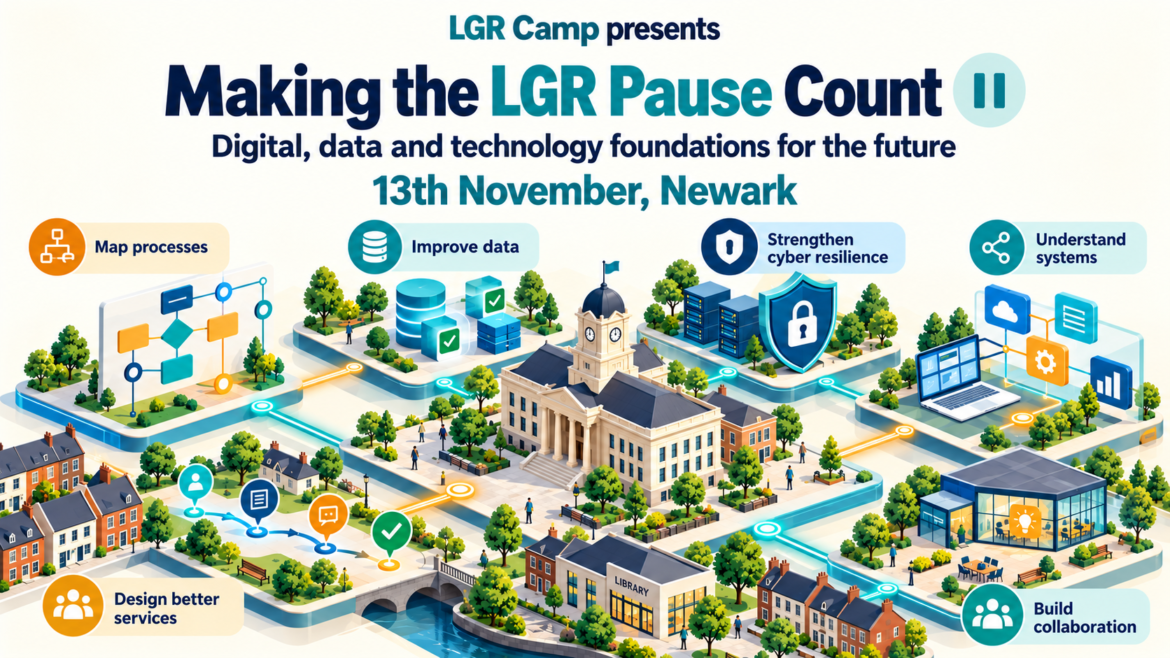
The 2nd event to be held at Newark in this series, this highly interactive session will look at the following topics:
Why Process Mapping Matters to Councils going into LGR
Service design and citizen checkpoints
Cyber resilience through transition
Data, systems and contracts
Process mapping and knowledge capture
Digital front door, low-code and AI
People, skills and cross-council collaboration
Day one and beyond: how Cumberland delivered digital through LGR
Craig Barker, Senior Manager, Digital & Customer Experience, Cumberland Council
When Cumberland Council came into being on 1 April 2023, it brought together services from Allerdale, Carlisle and Copeland district councils and part of Cumbria County Council. Behind the scenes, Digital, Data and Technology teams had to keep services running while building the foundations of a brand new organisation.
In this session, Craig Barker from Cumberland Council shares the DDaT journey from the inside. He’ll talk about how low-code was used to rebuild and harmonise processes quickly, and how the council approached its website: bringing multiple legacy sites together into one, deciding what to keep, merge or retire, and getting it ready for residents on vesting day.
Craig will be honest about what worked, what was harder than expected and what he’d do differently. There’ll be plenty of time for questions and discussion.
Questions to explore
- What had to be ready on day one, and what could wait?
- Where did low-code help most, and where were its limits?
- How do you merge several council websites without losing residents along the way?
- What would you tell a council about to start its own LGR journey?
Before the TOM, before the Tech: where does Service Design fit in LGR?
Anne-Louise Arkle, Head of Service Design & Digital Adoption, North Yorkshire Council
When North Yorkshire Council was created, eight organisations came together to form one new council serving around 600,000 citizens and more than 10,000 staff.
Anne-Louise led digital delivery through that reorganisation, from a harmonised website, staff intranet and IT self-service portal to over 100 online forms and AI-enabled customer support tools. She has also led the growth of North Yorkshire’s customer portal, which consistently achieves over 80% online take-up for the services it manages.
LGR forces hundreds of decisions about which processes, policies and systems survive into the new council. Too often these are driven by technology timelines, contract end dates or the Target Operating Model, while the people who actually use the services are consulted late, if at all.
In this session, Anne-Louise will share how North Yorkshire approached service design through reorganisation and where it sat alongside technology design, the TOM and system selection. We’ll also explore “citizen checkpoints”: practical ways of building user testing into an LGR programme, so that every convergence and harmonisation decision is checked against the residents, businesses and staff who rely on the service.
More Agenda Items to Follow

